English
 português
 français
 italiano

-webp.webp "Hatshepsut temple")


Two days to Dendera, Abydos & Luxor from Safaga port
Enjoy a wonderful journey from Safaga port to Dendera, Abydos and the city of wonders Luxor City in two days.
Discover the awesome temple of pharaoh Seti I at Abydos, and the amazing temple of Goddess Hathor at Dendera, with our professional licensed tour guide.
Also get the chance to explore Luxor city the capital of the pharaohs, when you start your tour to the impressive temple of Karnak, the magnificent tombs of the Valley of the Kings, the Colossi of Memnon, and the unique temple of the female pharaoh Hatshepsut.
Lunch will be served at a local restaurant.
There are many attractions in Luxor that you can visit during your trip to Luxor and enjoy. Safaga Shore Excursions give you the opportunity to spend a full day in Luxor, learn about its ruins, and tour its cities, all with the help of your tour guide from Happy Egypt. Enjoy some luxor attractions during your tip .
Tour itinerary
Day 01 Tour to Dendera and Abydos from Safaga Port
Our driver / representative in Happy Egypt will pick you up from to drive to Dendera . Your guide will meet you in Dendera to commence your trip to,
Dendera:
Dendera or Tentyra was the capital of the 16th Nome of Upper Egypt.
The temple is dedicated to the goddess Hathor. Hathor (The Cow) was identified by the Greeks as Hera or Aphrodite. She was the goddess of love, dance, and music. Before you reach the temple, there are two structures in the precinct of the temple, the Mamisi or “the birth house” and the Roman Basilica.
The temple of Hathor was built in the time of the Greeks. It is in very good condition with amazing astronomical scenes on the ceiling. There are 24 Hathoric columns bearing the roof of the 1st hypostyle hall.
The temple contains very beautiful scenes such as the representation of the goddess Nut, and the zodiac on the top of the temple. You will admire the good carvings in the crypt at the rear part of the temple behind the sanctuary.
Queen Cleopatra VII appears on the back exterior wall making an offering to the goddess. A small temple dedicated to Isis is in the back of Hathor’s temple. A pool with a Nilometer is to the right of the temple.
Abydos:
Abydos or ( Abdju ) was the center of the god Osiris ( god of death and eternity ). It was the pilgrimage center of ancient Egypt. Everyone had to visit it once at least in his lifetime. It was as well the center of the cemeteries of the 1st and 2nd dynasties. It was thought that Abydos was the gate to the afterlife.
The temple you will visit there is the temple of King Seti I ( 19th dynasty ). The temple was begun by Seti I and finished by his son Ramses II. Ramses II’s section is now damaged.
The temple is very unique among Egyptian temples due to the quality of the paintings. The temple was dedicated to seven deities, Osiris, Isis, Horus, Amon-Re, Ptah, Rehorakhty, and Seti I as a god.
There are some amazing scenes, you will admire their quality and their craftsmanship, such as the establishment of the Djed pillar and the different offering scenes.
One of the most important halls of the various halls and rooms of the temple is the Hall of Cartouches, which contains about 72 oblong shapes of the names of kings of Egypt from Menes to Seti I. It is a very important chronological list. With Egypt day tours you can discover more.
In the back of the temple is the Osirion, where it was thought that the head or the heart of Osiris was thrown there by Seth.
Ramses II built a small temple, to the north of his father’s temple, but it was almost ruined.
NOTE: Photography in the temple of Seti I is without flash.
Day 02 Luxor tour / Back to Safaga port
The Valley of the Kings:
The Valley of the Kings is one of the most important highlights of the development of the construction of the tomb in Egypt. It was called by the Ancient Egyptians (Ta-Maat) or the place of justice and truth. It is one of the most important attractions in Luxor
It is a long, narrow defile in the west bank of Luxor, which was part of ancient Thebes. It was the burial site of almost all the pharaohs of the New Kingdom (1550-1080 BC).
The plan of the tombs varies considerably but consists essentially of a descending corridor interrupted by deep shafts to baffle robbers and by pillared chambers or vestibules. At the farther end of the corridor is a burial chamber with a stone sarcophagus in which the royal mummy was laid and store chambers around which furniture and equipment were stacked for the king’s use in the underworld.
In many cases, the walls were covered with sculptured and painted scenes depicting the dead king in the presence of deities, especially the gods of the underworld, and with illustrated magical texts similar to those found in funerary papyri, designed to help him on his Egypt day tour through the Netherworld.
You will just visit three tombs of the opened ones during Hurghada tours, your guide will recommend you the best three tombs to visit.
Hatshepsut Temple:
The temple of Hatshepsut at El Deir El Bahary is unique among the Egyptian temples. It is built in three terraces to commemorate the coronation of Hatshepsut.
Hatshepsut’s famous expedition to the land of Punt (Somalia) is depicted on the second terrace.
Hatshepsut is the daughter of Thutmosis I, the sister-wife of Thutmosis II, and the mother-in-law of Thutmosis III.
She ruled Egypt around (1478) BC for 20-24 years and died naturally from diabetes.
The temple is now called Al Deir El Bahary, which means in English (the northern monastery) because the temple was used by the Christians for a while.
It is really amazing temple, you will like and enjoy it.
The Colossi of Memnon:
You will finish or start your tour of the west bank by a photo stop at Colossi of Memnon, two impressive statues (18 meters) high, left from a huge temple built by Amenhotep III.
They are now called Memnon, after the name of Aga Memnon, when the statues were making sounds created when the wind blew through the cracks of the statues at dawn.
It is a photo stop.
Karnak Temples:
Egypt day tours help you to know more about the Karnak complex is the largest religious complex ever built in the universe till now.
The “Karnak” is Arabic for “the fort” or “the protected area”. But the complex was known as ” pr _ Imn” or” the house of Amon” for the ancient Egyptians, after that the name was changed by the Greeks to “ipt _ swt” or “the northern thrones”.
The complex was dedicated to the god Amon or Imn ” the hidden “, who was just a little, unknown local deity. When Luxor became the capital of Egypt, the god’s importance was increased. He then became like a national god. He was the creator, the sustainer, and the lord of the gods. His consort was the goddess Mut. The couple adopted the god “Khonsu” the moon god.
The complex was begun in 2000 BC, expanded through 1700 years, and is considered not completed.
You will approach the complex by the dock which leads you to the sphinx avenue, which takes you to the unfinished pylon “gate” of the temple.
In the 1st open court is the chapel of the Nubian king Tahraqa. To the right of the open court, is the small temple of Rameses III.
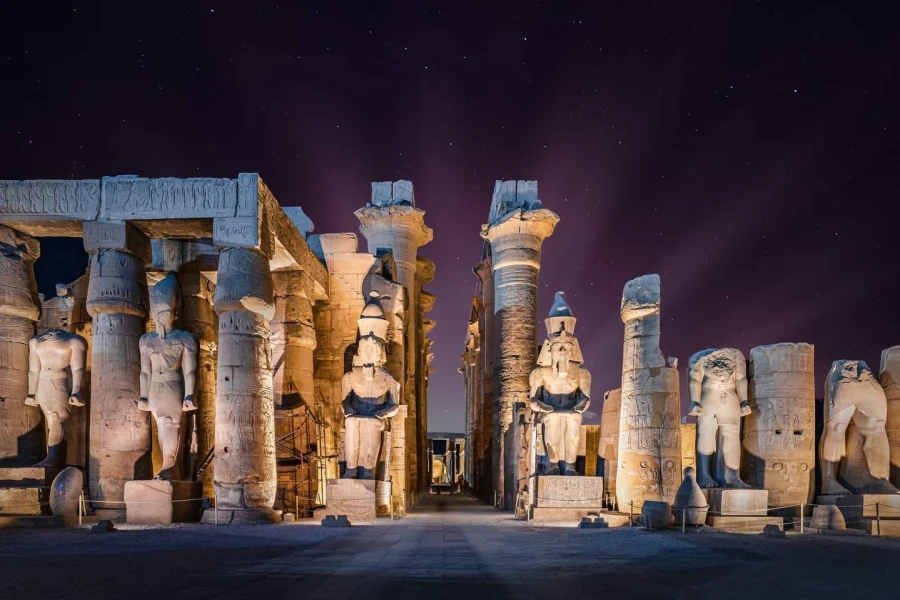
The great hypostyle hall is an awesome place with its 134 columns.
The obelisks of Tuthmosis I and Hatshepsut stand like two needles among the structures of the complex.
The sacred lake is amazing, was used for the purification of the priests.
The complex is very impressive. Don’t miss it.
Tour included
- Safaga port pick up and drop off.
- Safaga port permission
- 5* Luxor hotel on B.B basis.
- All transfers.
- Entrance fees.
- 2 Lunch meals at a local restaurant.
- Air-conditioned coach.
- Licensed tour guide.
Tour excluded
- Tips for guide and driver.
- Drinks.
- Personal expenses.
Notes
- Children from 1-5 years are free of charge.
- Children between 6-11 years get 50% off.
- All prices are in US Dollars, but Egyptian Pound, English Pound & Euros are accepted.
- These rates do not apply during peak seasons, such as the Christmas, New Year and Easter.
Prices Per Person
| Person | Price |
|---|---|
| 1 - Person | USD 600 |
| 2 - 3 Person | USD 390 |
| 4 - 7 Person | USD 290 |
| 8 - 15 Person | USD 240 |




-webp.webp)
-webp-webp.webp)
-webp-webp.webp)
-webp-webp.webp)
-webp-webp.webp)
-webp-webp.webp)
-webp-webp.webp)
-webp-webp.webp)
-webp-webp.webp)
-webp-webp.webp)