English
 português
 français
 italiano

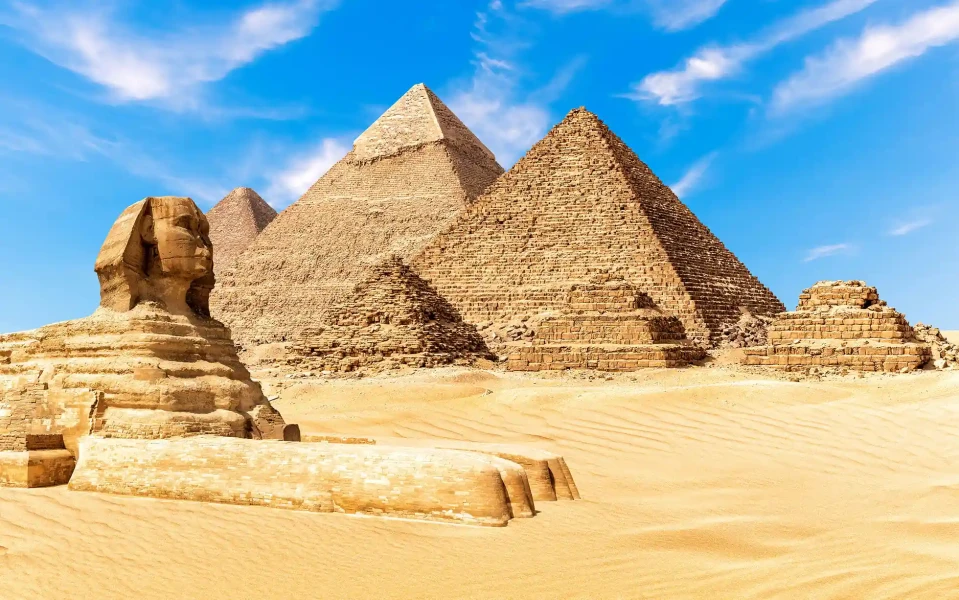
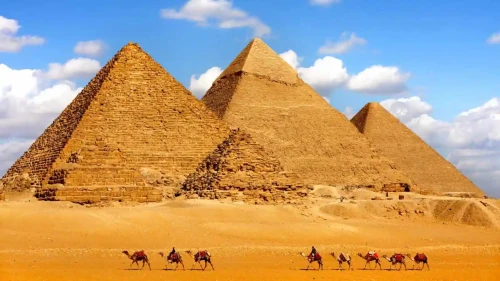
Egyptian pyramids are one of the greatest monuments of ancient Egypt. They are still intriguing travelers and amateurs of history and architecture, as well as being one of the most famous symbols of ancient Egypt. Pyramids were considered as the tombs for the Egyptian pharaohs and their close family members, this is the reason why these structures were so impressive, as well as being a great showcase of the pride of the ancient Egyptian civilization as far as architectural, mathematical, and organizational skills are concerned. Pyramids in Egypt: find out more about the history of pyramids, interesting facts, and everything related to pyramid construction, from Giza to Saqqara and Dahshur.Discover more Facts about Egyptian History and explore the fascinating heritage of ancient Egypt.
The Egyptian Pyramids: History, Secrets & Facts
The pyramids of Egypt are undoubtedly some of the greatest relics of antiquity that have stood the test of time. These gigantic tombs were constructed ages ago and still do not fail to tempt tourists, historians, archaeologists and the like.
From the world's most iconic pyramid – the Great Pyramid of Giza – to the world's oldest – the Pyramid of Saqqara – the pyramids demonstrate the ever greater achievement of ancient Egyptian architecture, engineering, mathematics and construction.Saqqara and Dahshur are also important pyramid sites that reveal the development of ancient Egyptian pyramid architecture.
What Are the Egyptian Pyramids?
The Egyptian pyramids are pyramid-shaped constructions built mostly as tombs for the country's pharaohs and their consorts during the end of the third millennium to the end of the second millennium.
Pyramid construction was a very long development, starting with very early examples of monumental tomb architecture before the familiar pyramid shape of the Old Kingdom.
History of the Egyptian Pyramids
The origins of the Egyptian pyramid revolve around the design of large royal burial monuments. Previously royal tombs were constructed by style, but architects try different new and more elaborate ideas.
Djoser's Step Pyramid, at Saqqara, is seen as a significant step in the evolution of the pyramid. Constructed by the architect Imhotep, during the Third Dynasty, it was created by stacking a number of levels of stone.
Later the pyramid builders used the shape of the smooth-sided pyramid. These design refinements led eventually to the great pyramids at Giza.
The Great Pyramid of Giza
The Great Pyramid of Giza is the largest of the three Giza Pyramids and the famous monument in the Giza Plateau, Egypt. It was commissioned by the Egyptian Pharaoh Khufu and constructed during the Fourth Dynasty.
The pyramid was originally faced with smooth casing stones, which has left its surface looking polished. Even today, much of the casing is missing, but the pyramid is still an incredible feat of ancient construction.
The Great Pyramid remains the only of the Seven Wonders of the Ancient World to still exist.
The Pyramids of Giza
There are three pyramid complexes in the area. They belong to the pharaohs Khufu, Khafre and Menkaure.
Pyramid of Khufu
The Pyramid of Khufu, or Great Pyramid, is the largest at Giza. Its huge size and perfect structure is a sign of the organization of ancient Egyptian civilization.
Pyramid of Khafre
The Pyramid of Khafre is slightly smaller than the Great Pyramid, but looks taller as it was built on higher ground. A few of the original casing stones near the top are still in place.
Pyramid of Menkaure
The Pyramid of Menkaure is the lowest of the three primary pyramids at Giza. It was built out of both limestone and granite, representing the diverse building stones involved in ancient Egyptian monuments.
How Were the Egyptian Pyramids Built?
One of the most interesting questions you can ask about the Egyptian pyramids is how primitive builders without the benefit of modern machinery were able to put together such large structures
Archaeology suggests the quarrying, moving, cutting and setting of enormous stone blocks was done by groups of large, organized teams of workers. Various kinds of tools, transportation, ramps, sledges and teamwork were probably essential.
The details of their construction are still under archaeological investigation and debate with regard to how the huge stones were raised and transported to such elevations.
Where Did the Pyramid Stones Come From?
There were different types of stones that the builders used when constructing the pyramid. For the most part, the pyramid were made from local limestone but the better quality limestone and granite was mined elsewhere.
Moving these heavy materials was an important task which was very well planned and organized. The Nile river was an important resource in transport heavy materials over long distances.
Who Built the Egyptian Pyramids?
The building of Egyptian pyramids was carried out by massive organized labor groups rather than the conceptual mass of just slaves alone.
Archaeological findings at Giza have found evidence of settlements linked to the workers, such as housing, the ways of producing food, and the facilities that served the builders.
These insights also tell us a lot about the socio-economic organisation of ancient Egypt.
Why Were the Pyramids Built?
First and foremost the purpose of the pyramids was that they were connected to the funeral of kings, and believed to be connected to the Egyptian afterlife. Pharaohs were interred in or near huge funerary temples and structures.
The overall form of the pyramid was, of course, also linked to religious ideas of Egyptian life and the concept of what happened to a dead person after death.
The Step Pyramid of Djoser
The Step Pyramid of Djoser at Saqqara: An important link in the development of the pyramids at Saqqara.
Built under Pharaoh Djoser's rule, the step pyramid is made up of a series of stacked platforms forming its pyramid shape and is thought to be one of the earliest monumental stone structures in Egypt.
There are other architectural features including ceremonies, courtyards and other building structures within the enclosure.
Pyramids at Dahshur
Dahshur is an important site for the study of the evolution of pyramid building. Among its monuments are a couple of pyramids, including the so-called Bent Pyramid and the Red Pyramid.
What makes the Bent Pyramid really fascinating is the angle of the walls shifts halfway up the pyramid, which seems to show that the builders were experimenting with the design.
The Red Pyramid demonstrates the progression to the true slope of a smooth-sided pyramid and is one of the most well-preserved examples of this type.
-webp.webp)
-webp-webp.webp)
-webp-webp.webp)
-webp-webp.webp)
-webp-webp.webp)
-webp-webp.webp)
-webp-webp.webp)
-webp-webp.webp)
-webp-webp.webp)
-webp-webp.webp)