English
 português
 français
 italiano

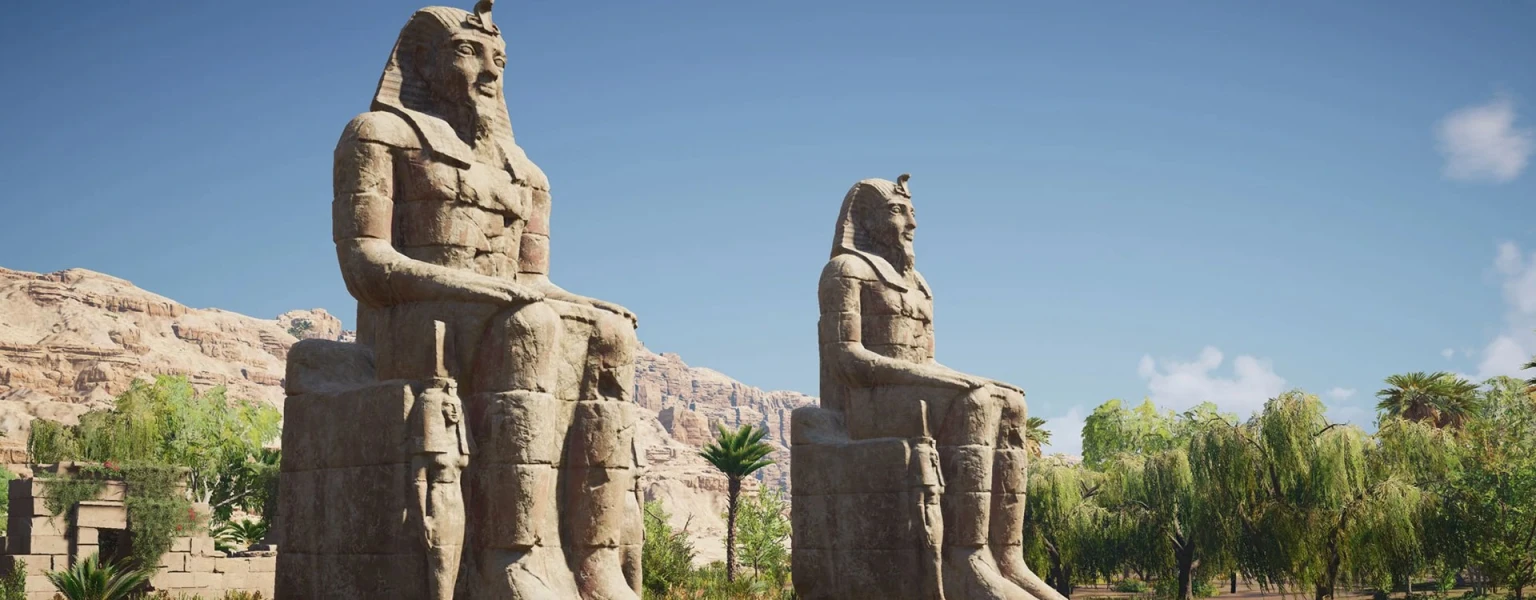

Meet the Colossi of Memnon: 3,400 Years of Egyptian Majesty
The Colossi of Memnon are two massive stone statues that have stood for nearly 3,400 years in the Theban Necropolis, located west of the River Nile near the modern city of Luxor. These grand statues depict Pharaoh Amenhotep III, who reigned during the 18th dynasty of ancient Egypt. The statues are among the most iconic monuments included in Egypt tours and Luxor tours, attracting thousands of visitors interested in ancient Egyptian history and architecture.
When in their heyday, the Colossi of Memnon guarded the entrance to the pharaoh's temple complex, welcoming guests and pilgrims who came from all directions to honor the king who had passed away. Encircling the statues were expansive courtyards, halls, and chapels that displayed the riches and authority of Amenhotep III's rule through their elaborate carvings and sculptures.
Nevertheless, the temple complex has suffered over the ages, and hardly much of its original splendor is visible today. Even after suffering weathering, natural disasters, and human intervention, the Colossi of Memnon captivate attention as timeless reminders of ancient Egyptian culture.
Another of the widely famous legends transmitted in memory by travelers and concerning the Colossi of Memnon, the enigmatic "song" at the moment of dawn made by the statue located to the north. The ancient texts attest that at the moment the light began to illuminate the Colossus and it heated up, this sound, the strange sound of a harp of a single string, some mentioned. And so much that he captured the natural beauty of the thing that any visitor inclined to believe that this sound was the voice of the pharaoh would be awarded magical powers and abilities by this sound. This was what made the famous Colossi a center of pilgrimage.

A Journey Through Time: The Fascinating History of the Memnon Colossi
The Memnon Colossi, Engraved around 3,400 years ago from enormous slabs of quartzite sandstone, these commanding sculptures formerly graced the entrance to Amenhotep III's mortuary temple, serving as a reminder of the pharaoh's immense riches and influence at the pinnacle of the New Kingdom era. You can learn a lot through Egypt tours Where you can choose a suitable trip to Luxor to discover its ruins
At the front of Amenhotep III's temple, the Colossi of Memnon welcomed guests and pilgrims who came to honor the esteemed pharaoh. Originally, they were a part of a large complex that spanned the Theban necropolis. Encircling the doorway like massive sentries, the sculptures showed Amenhotep III astride his throne, his eyes fixed in the distance.
Each statue, which was over eighteen meters high and weighed an estimated 700 tons, was decorated with elaborate carvings that included hieroglyphic inscriptions honoring the pharaoh's divine ancestry and achievements. Huge courtyards, halls, and chapels filled with sculptures, obelisks, and reliefs surrounded the colossi, creating a magnificent scene worthy of the head of one of the most potent ancient empires. Luxor trips provide you with an irreplaceable opportunity. You can choose a trip to the city full of legendary temples and learn the secrets of the great pharaohs.
Amenhotep III's temple deteriorated throughout the ages as the weather and passage of time wore down its formerly magnificent constructions. With the exception of the Colossi of Memnon, which have survived as enduring representations of the majesty and grandeur of ancient Egypt, little much of the original complex is visible today.
Where is the Colossi of Memnon located?
The Colossi of Memnon are located on the west bank of the Nile River, opposite the city of Luxor. This area, known as the Theban Necropolis, is rich in historical and archaeological sites, making it a must-visit destination on Egypt day tours. The statues are situated at the entrance of what was once Amenhotep III's mortuary temple, one of the largest temples built in ancient Egypt.
The "vocalization of Memnon" is a phenomenon associated with the Memnon Colossi that is one of its most fascinating features. There were old stories that at dawn one of the statues would make an enigmatic sound, like the plucking of a harp chord. Visitors and pilgrims traveled from far and wide to witness this phenomenon, which was ascribed to the stone expanding in the morning light. They thought the stone represented the voice of the departed pharaoh, bestowing gifts from the afterlife. - A tour of the Valley of the Kings, the Temple of Hatshepsut, and the Colossi of Memnon, one of the most beautiful tours during which you can explore the great statue with a tour guide to tell you all the history of the great statue.

Standing Tall: The Historical Significance of the Memnon Colossi in Luxor
- Significance in Politics:
Constructing such massive monuments, such as the Memnon Colossi, was an announcement of might and dominion as much as a display of piety. He intended these major building projects to reflect his greatness, wealth and legitimacy, to assert his dominance of the nation and other nations dependent on Egypt and solidify his position on throne through the erection of these magnificent temples. - Discoveries in Archaeology:
The Memnon Colossi have helped in the development of egyptology and archaeology. Their huge size and clear locations served as a visible landmarks which stimulated the imagination of the ancient travelers and early investigators of Egyptology. This monumental statues are more familiar in the history, especially from the ancient Greeks and Romans periods as it’s one of the most significant discovery, excavation, investigation, in terms of Egyptian arts, architectures and worship. - Preservation Activities:
Even though the pollution, natural erosion and the excessive presence of tourists have put a threat on Memnon Colossi, considerable effort has been made to preserve it for the generations to come. Aiming to stop its dilapidation and ensure its sustainability, conservation programs supported by local governments and international organisations were put into motion. This enabled tourists from around the world to come and stare at the majestic statues of Memnon Colossi that are considered among the symbols of Egyptian cultural heritage.
Who is Memnon?
In Colossi of Memnon history, Memnon is a very famous figure from Greek mythology: He was a mighty king of Ethiopia and a great warrior known for his valor in the Trojan War, fighting on the side of the Trojans. Memnon was said to be the son of the dawn goddess Eos. Ancient art depicts his heroic yet tragic death at the hands of Achilles, thus elaborating the myth. Such a mythical connection lends an enchanting weirdness into those colossal statues, elevating them beyond just monuments into emblems of legend and mystery. making the attractions interesting for anybody on Luxor excursions or Egypt tour packages
Seeing the Statues of Memnon represents a unique experience in witnessing the powerful blending of Egyptian culture and ancient mythology. The ever-iconic giants stand eternal as witnesses to the cultural crossroads that shaped not just Egypt but strikes also beyond into other civilization. Most Egypt Nile river cruise include the statues in their itineraries, along with excursions through Luxor. Their presence is a call to travelers to delve into the historical, mythological, and artistic layers lying deep under the truly singular heritage of Egypt

The origin of Colossi of Memnon’s name
Opinions for why Akhenaten built Colossi of Memnon have a connection to Greek mythology as the statues were named “Colossi of Memnon.” The statues were venerated in the Hellenistic period with Memnon, a son of Eos, the goddess of dawn, who was assumed to be an Ethiopian king. What probably gave them this character was that Memnon was reported to have been killed by Achilles during the Trojan War. The Greeks had thought that one of the statues issued a sound in the morning, and this sound was thought to be that of Memnon addressing his mother Eos. This occurrence where the stone got heated in the morning light as people passed nearby made the statues a landmark for the ancient travelers and contributed to their lore, guaranteeing them inclusion in the many forms of Classic tours in Egypt..

When were the Colossi of Memnon built?
Amenhotep III was one of ancient Egypt's more prolific Pharaohs, from ancient Egypt's 18th Dynasty and was king of Egypt from 1386 to 1349. During his reign, ancient Egypt prospered, and this period of history became known as the Old Kingdom of Egypt. Architecture within the Old Kingdom proved bountiful, and much of this can be viewed to this day.
Most of the amazing ancient structures were completed during the 39 years Amenhotep III was in power; perhaps one of the most awe inspiring structures that this pharaoh is remembered for are the Colossi of Memnon, which were built at some point before 1350BC. The Colossi of Memnon were erected in front of a fake doorway of King Amenhotep III's temple; the king's temple was used as a depot but was shortly afterward destroyed in an earthquake that had struck not too long after the pharaoh's death. At the beginning the Colossi of Memnon were created to be a funeral temple to King Amenhotep III, but this ancient landmark has had quite a bit of history including surviving the great earthquake during the 27th that caused it to crack, where it was restored by roman emperors during the time of the Roman empire inside of ancient Egypt.
The Memnon Colossi: Unraveling the History of Luxor's Ancient Guardians
Two massive stone statues called the Colossi of Memnon sit on the west bank of the Nile River in Egypt, just outside of Luxor. The figures were erected as entrance guardians for a grand funeral temple of Pharaoh Amenhotep III in the 14th century BC. It is one of the largest, and most extravagant structures of its time, topped by these twin figures of the king on his throne.


-webp.webp)
-webp-webp.webp)
-webp-webp.webp)
-webp-webp.webp)
-webp-webp.webp)
-webp-webp.webp)
-webp-webp.webp)
-webp-webp.webp)
-webp-webp.webp)
-webp-webp.webp)