English
 português
 Deutsch
 français
 italiano

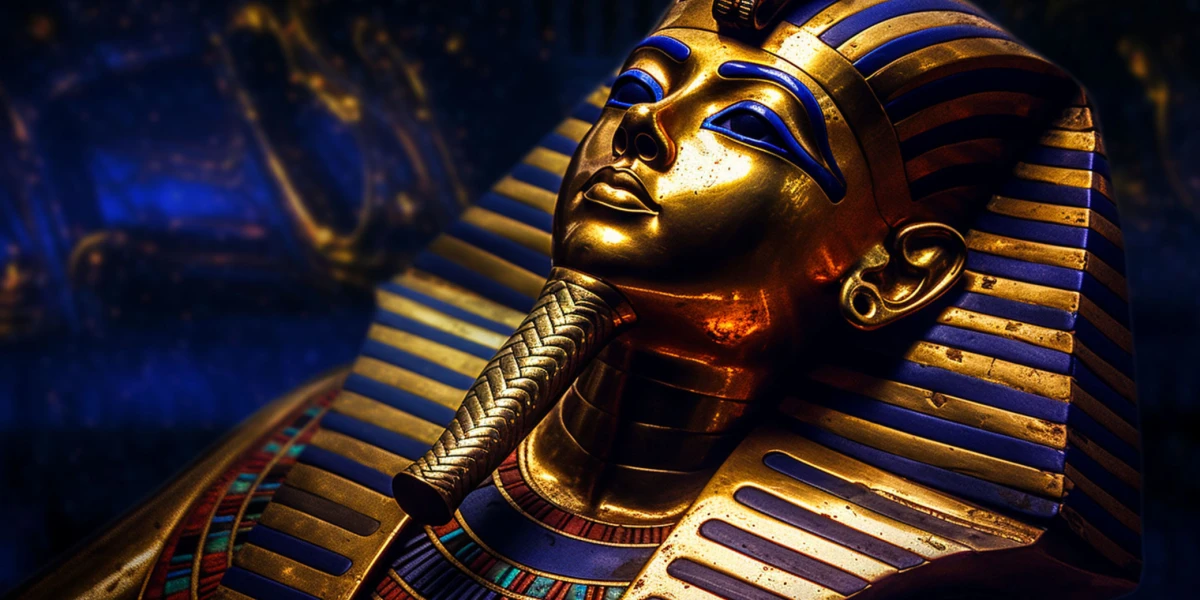

King Tutankhamun, often referred to as King Tut, is one of the most famous and enigmatic figures in ancient Egyptian history. His reign was brief, yet his legacy has captivated historians, archaeologists, and the general public for nearly a century. This article delves into who King Tutankhamun was, his historical context, the discovery of his tomb, the legend of his curse, and the theories surrounding his untimely death.
No figure, perhaps in ancient Egyptian history, is both so famous and yet enigmatic as that of King Tutankhamun. His reign was short, but his legend has enthralled historians, archaeologists, and the public for generations.
Who Was King Tutankhamun?
Tutankhamun was born in the New Kingdom period of ancient Egypt in 1341 BC as Tutankhaten. He assumed his throne very early, at about nine or ten years old, and ruled for some ten years before he died around 1323 BC. Tutankhamun was the son of Akhnaton, the most controversial pharaoh who tried to shift traditional polytheistic religion onto a single deity, Aten, the sun disc. This was a radical religious change and one that shook the very foundations of society in Egypt.
During the reign of Tutankhamun, traditional polytheism returned, and the zeal for worshiping the chief deity, Amun, was renewed. He changed his name from Tutankhaten to reflect this socio-political move. His reign wasn't noteworthy for grand achievements or military conquests; instead, it had become one of restoration and rebuilding from his father's tumultuous reign.
Discovery of His Tomb
The discovery of the tomb of Tutankhamun by archaeologists is one of the best archaeological finds made in the 20th century. It was discovered on November 4, 1922, by another British archaeologist named Howard Carter in the Valley of the Kings. Only after all this persistence and hard work did they stumble upon the nearly intact tomb of Tutankhamun.
The tomb was known as KV62 and turned out to be remarkably well-preserved, with many artifacts inside. These treasures were many: from chariots and thrones to jewelry and statues, and ended up being conceived probably the most recognized ancient artifact, which is the golden burial mask of Tutankhamun. The finding gave a totally new insight into how rich and artistic ancient Egypt is. Perhaps the most remarkable thing about this tomb was that it lay nearly unmolested by grave robbers.

The Curse of Tutankhamun
The discovery also sparked colorful rumors about a curse. So, according to the so-called "Curse of the Pharaohs," misfortune, illness, or even death would await whoever disturbed the tomb of an ancient Egyptian pharaoh. Such legends found roots in the imagination of the public following the sudden, inexplicable death of Lord Carnarvon, occurring in April 1923—just some months after the discovery of the tomb. This merely fueled sensationalist stories in the press when Carnarvon died from an infected mosquito bite.
Over the years, many others connected with the discovery and excavation of his tomb died suddenly and unnaturally, too, which adds to the legend of the curse. Nevertheless, many writers have attempted to prove that there is no curse at all, indicating that each man died due to his natural weaknesses and emphasizing that many others associated with the excavations lived into old age without problems. Today, most scholars view the legendary curse as a compound of superstition and coincidence, not as an actual supernatural event.

The Mystery of Tutankhamun's Death
The reason for Tutankhamun's death has always been one of the longest-standing mysteries relating to him. Because he died so young, by 19 years, he died very young. There has been much speculation and study into the cause of his untimely death. Some early theories put it that he might have died of murder because what appeared as a skull fracture was misinterpreted; however, this is now being dismissed after further analysis.
In 2005, when a full-body CT scan of the mummy of Tutankhamun was conducted, it gave some new information. It had in his body a lousy leg fracture a little while before he died. This may have resulted in an infection that proved fatal. DNA analysis done in 2010 revealed many other ailments that Tutankhamun had, such as disorders of the bone and malaria. These could have caused him to die due to a significantly reduced immune system.
Another theory postulates that Tutankhamun may have died from complications stemming from his genetic makeup. For example, evidence shows that Tutankhamun's mother and father were siblings, thereby increasing the risks of congenital disabilities and health problems in the young king. Several physical abnormalities on the remains of Tutankhamun, such as a cleft palate and a clubfoot portray this assertion.
One of the most interesting, mystery-shrouded figures in ancient Egypt must be King Tutankhamun.
One of the most interesting, mystery-shrouded figures in ancient Egypt must be King Tutankhamun. Although his reign during the 18th Dynasty was very short, it could bring about restitutions on religious aspects and cultural renewal in Classical Culture. His treasure-filled tomb, discovered with very few losses by Howard Carter in 1922, established an entirely new orientation to ancient Egyptian civilization and deeply marked the further development of archaeology and Egyptology.
Though widely discredited, the legend of the curse associated with his tomb does lend mystique to the story. His untimely death appeals through mystery and curiosity to researchers and historians who have been working relentlessly on this matter, trying to uncover more about his life and death through modern technology.
The legacy of King Tutankhamun speaks for itself across a land that has been able to capture, through the sands of time, a mystique that seems to enthrall human imagination worldwide. His story--full of mystery, discovery, and intrigue--ensures that the Boy Pharaoh shall always hold an extraordinary place within the annals of history.


-webp.webp)
-webp-webp.webp)
-webp-webp.webp)
-webp-webp.webp)
-webp-webp.webp)
-webp-webp.webp)
-webp-webp.webp)
-webp-webp.webp)
-webp-webp.webp)
-webp-webp.webp)